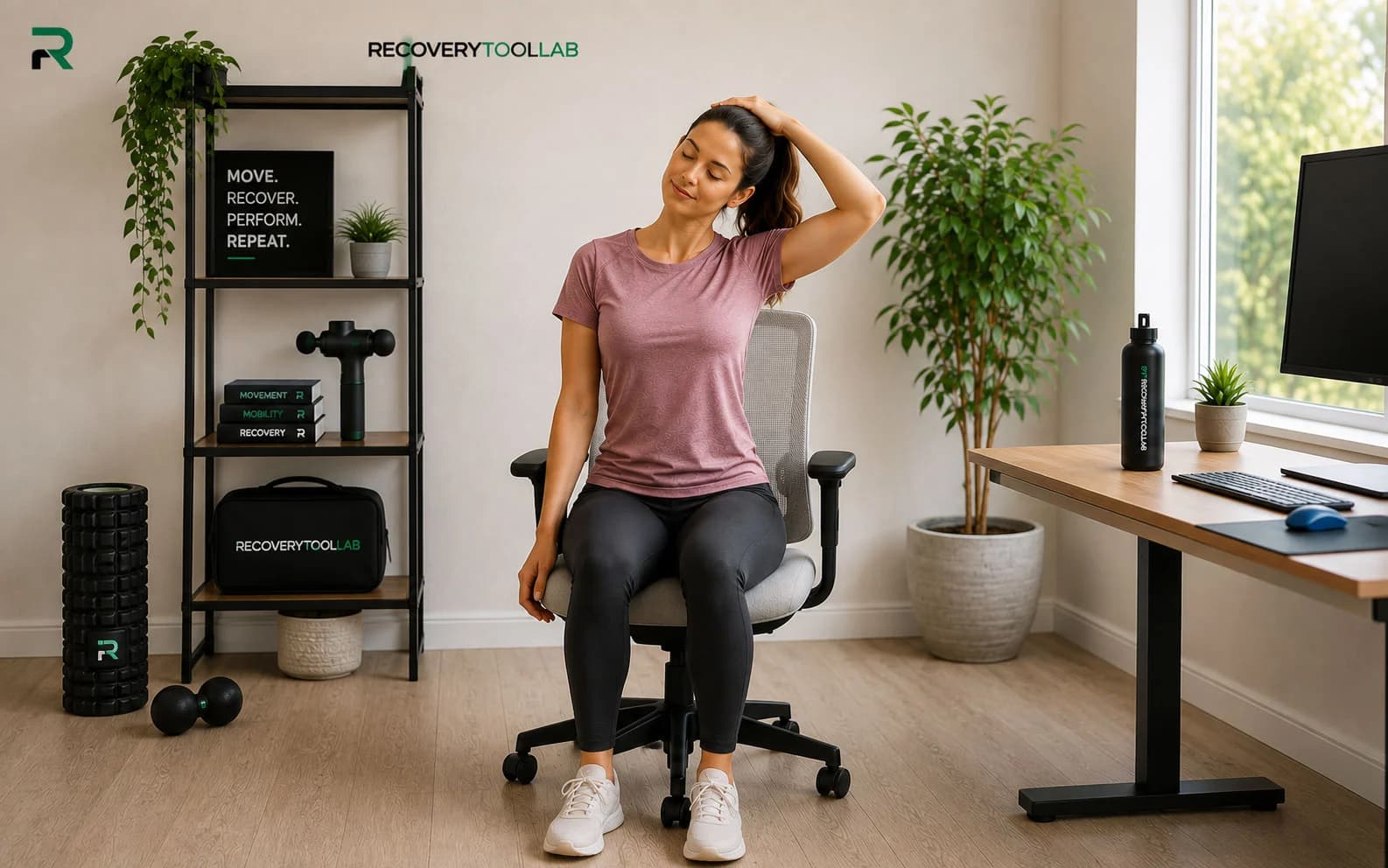
What mobility means here
In everyday use, mobility is the ability to access and control enough range of motion for a task. Flexibility is often used more narrowly for the range available at a joint or the extensibility measured during a stretch. The words overlap, but the practical point is simple: touching a farther endpoint is not the only sign of useful movement.
For desk workers, mobility work can provide movement variety after time in a static position. It should not be sold as a way to “fix posture” or permanently reshape a muscle in minutes.
Why you may feel stiff after desk work
Holding any position for a long time can feel uncomfortable or stiff, but the sensation does not reveal one universal anatomical cause. It may change with position, activity, workload, stress and other factors. Avoid assuming that one muscle is shortened or that your posture is damaged based on sensation alone.
Public-health guidance focuses on behavior rather than a perfect posture: adults should move more and sit less. The guidance does not identify one required break frequency, and it encourages inactive people to begin with small amounts of activity. Read the U.S. guidance.
Four principles for a realistic routine
Use several directions
A desk day is repetitive, so a mobility routine can be varied. Gentle reaching, turning, bending and hip or ankle movement may all have a place when comfortable. No single drill covers every joint or task.
Work within a controlled range
A strong stretching sensation is not proof of a better result. Move slowly enough to remain in control and stop before sharp pain, numbness, tingling or loss of control. If an area is injured, recently operated on or medically restricted, generic mobility advice is not a substitute for professional guidance.
Repeat more often instead of forcing more
Gradual exposure is easier to evaluate than an aggressive session. A systematic review found that stretching training can improve joint range of motion in healthy participants, but the research does not support using one universal program for every person or joint. Review the evidence.
Connect mobility to activity
Range is most useful when it supports something you do: walking comfortably, reaching overhead, getting into a training position or changing posture during work. Mobility does not replace aerobic activity or strengthening.
A general movement menu
This is a menu, not a prescription. Choose movements that are familiar and comfortable, and seek individualized advice if symptoms or medical conditions make that uncertain.
- Stand and sit with control
- Walk at an easy pace
- Reach the arms overhead within a comfortable range
- Turn the upper body gently from side to side
- Shift weight between the feet
- Move the ankles through comfortable flexion and extension
- Explore hip flexion and extension without forcing either endpoint
For a post-work sequence centered on changing position and walking, see Recovery After Sitting All Day. For more focused context, read Hip Mobility for Desk Workers.
Walking and movement breaks
Mobility sessions are not the only way to add movement. Brief walking breaks have been studied as interruptions to prolonged sitting. Meta-analyses report improvements in some short-term post-meal metabolic markers compared with uninterrupted sitting, with light walking generally producing a larger acute effect than standing alone. These laboratory outcomes do not establish a treatment for musculoskeletal discomfort. See the systematic review and meta-analysis.
Because guidance does not specify one ideal interval, a meeting transition, water break or calendar prompt can be a reasonable cue. The best cue is one you can follow without disrupting safety or essential work.
What mobility tools can and cannot do
A strap, mat, roller or massage ball can make a routine easier to organize. Foam-rolling studies in healthy adults suggest possible range-of-motion benefits, especially with repeated training, but results vary by muscle or joint and do not prove that rolling breaks adhesions or corrects posture. Review the foam-rolling evidence.
Use a tool because it helps you perform a chosen task, not because its marketing says everyone has the same hidden restriction. Our recovery-tool guide for desk workers compares categories without ranking them.
Measuring progress without chasing extremes
Progress can mean moving with less hesitation, reaching a task-specific position more comfortably or maintaining a routine consistently. Maximum range is not automatically better, and day-to-day variation is normal.
Use the same simple movement occasionally if you want a comparison. Avoid repeatedly forcing the endpoint just to test it. If function is declining or pain is changing, assessment is more useful than another self-test.
When general advice is not enough
Seek professional evaluation when symptoms are persistent, worsening or associated with injury. New weakness or numbness, bowel or bladder changes, difficulty walking, severe pain after trauma, or fever with back pain require prompt medical attention. MedlinePlus provides a fuller warning-sign list.
Is stiffness proof that a muscle has shortened?
No. A feeling of stiffness does not identify one tissue change or diagnosis. It can be influenced by position, activity and many other factors.
Is mobility the same as stretching?
Not exactly. Stretching can be part of mobility practice, while mobility also includes control and using range during movement.