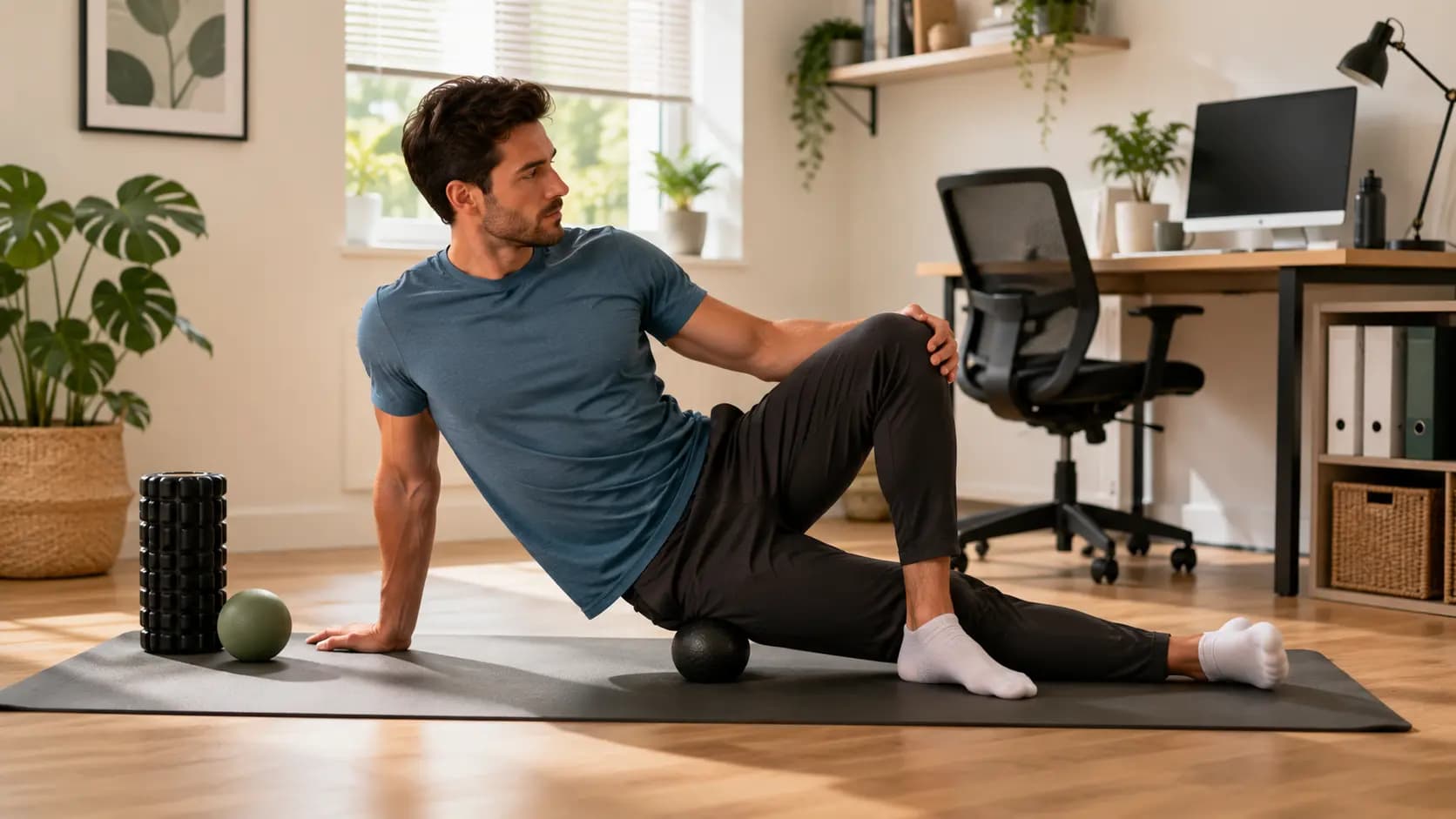
Hip mobility is more than a hip-flexor stretch
The hip moves in several directions, including flexion, extension, rotation and movement toward or away from the midline. Useful mobility depends on the task and on control, not simply the farthest position you can reach.
The iliopsoas group contributes strongly to hip flexion, but it is not the only structure involved in hip movement or discomfort. A clinical anatomy review describes the iliopsoas as a deep group composed of the iliacus and psoas muscles and emphasizes that evaluating iliopsoas-related problems can be difficult because symptoms overlap with other hip conditions. Review the anatomy article.
That is why it is too simplistic to assume that sitting has “shortened your psoas” or that one pressure point explains every stiff hip.
What a desk day changes in practice
Desk work keeps the hips in a relatively consistent position for long periods. The useful response is movement variety, not fear. Public-health guidance recommends moving more and sitting less, while acknowledging that evidence does not establish one universal sitting limit or break schedule. Read the U.S. guidance.
After sitting, some people feel better after walking or gently exploring hip motion. That response does not prove that a particular tissue was released or realigned.
A gradual hip-mobility framework
Begin with walking or weight shifts
Walking repeatedly moves the hip through flexion and extension without requiring a deep end-range position. If walking is comfortable and safe for you, it can be a straightforward transition from desk work.
Explore flexion and extension
Bring a knee forward only as far as you can control, then allow the leg to travel behind you during a comfortable step or supported movement. Avoid forcing the lower back or pelvis to create range that the hip is not comfortably providing.
Include rotation
Hip rotation matters for many everyday and athletic tasks. Explore it gently in a supported seated, standing or floor position you already know. Keep the range small if the movement is unfamiliar.
Add strength through comfortable range
Mobility is easier to use when you can control it. General strengthening can complement stretching or movement practice, but this article does not prescribe exercises for an injury or medical condition.
For a broader framework, see Mobility for Desk Workers.
What stretching evidence can and cannot tell us
Systematic-review evidence indicates that stretching programs can increase joint range of motion in healthy participants. It does not show that every person who sits needs the same hip-flexor stretch, nor does increased measured range establish that pain has been treated. Read the systematic review.
Use a tolerable intensity and progress gradually. A sensation of tension can guide comfort, but it cannot diagnose which tissue is responsible.
The psoas and iliacus in context
The psoas major and iliacus are commonly discussed together as the iliopsoas. They converge near the hip and contribute to hip flexion, while research also describes additional roles in hip and trunk function. Newer anatomical work has challenged some simplified descriptions of their distal tendon arrangement, another reason to avoid marketing claims that reduce the area to one lever or one “release.” See the anatomical study.
If you are considering a shaped pressure device for this region, start with What Is a Psoas Release Tool?. The phrase “psoas release” is a product and manual-therapy label, not a guarantee that a specific lasting physiological event occurs.
Where tools may fit
Rollers, balls, straps and targeted pressure tools can make a routine feel different. Reviews of foam rolling suggest possible range-of-motion effects, but that evidence cannot be transferred automatically to every device or to the deeper front of the hip. Review the foam-rolling evidence.
Targeted tools concentrate pressure near sensitive anatomy and require especially clear placement, intensity control and stop rules. RecoveryToolLab has not hands-on tested the Hip Hook. Our Aletha Hip Hook review separates the manufacturer’s intended use from independent evidence and identifies the limits of a documentation-based assessment.
Our unranked recovery-tools guide provides a broader category comparison.
Safety and professional evaluation
Do not press deeply into the abdomen or front of the hip without clear product instructions. Stop if pressure produces numbness, tingling, burning, throbbing, sharp pain or symptoms that travel. Aletha Health’s own safety guidance tells users of its tools to stop for numbness, tingling, burning or throbbing and to consult a provider after recent surgery or with a medical condition. Read the manufacturer’s safety notes.
Seek assessment for persistent or worsening hip symptoms, symptoms after significant trauma, difficulty bearing weight, or neurological symptoms. New weakness or numbness, bowel or bladder changes, or difficulty walking warrant prompt medical attention. See MedlinePlus warning signs.
Does sitting permanently shorten the psoas?
That conclusion cannot be made from a feeling of stiffness or from desk work alone. Hip sensations and range of motion have multiple influences, and individual assessment is needed when symptoms persist.
Do I need a psoas release tool for hip mobility?
No. Walking, active movement, stretching and strengthening can all be practiced without a specialized pressure tool. A tool is optional.