Recovery category
Editor's unranked guide
Best Recovery Tools for Desk Workers
An evidence-aware guide to movement, mobility, self-massage, heat and other recovery tools for people who spend much of the day sitting.
How this guide is evaluated →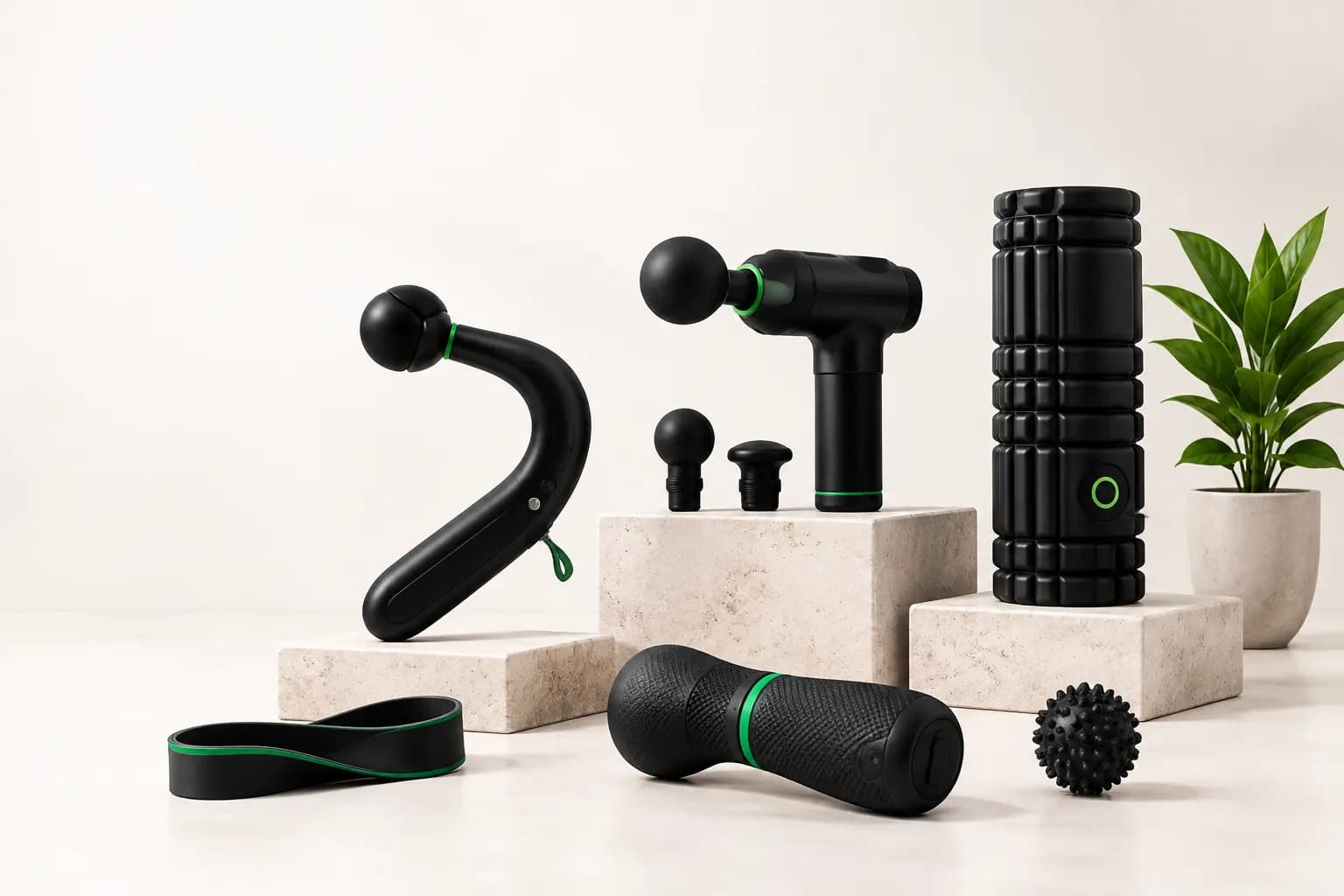
Quick picks
Choose by purpose, not rank
Unranked editorial guideRecovery category
Mobility tools
Mobility is the usable range of motion available for a task. A mat, strap or stable support can make it easier to explore positions, but the tool is not the adaptation: regular movement practice is. Gradual stretching training can increase joint range of motion in healthy adults, although results vary with the joint, person and program. See the systematic review.Recovery category
Self-massage and rolling tools
Foam rollers, massage balls and handheld rollers apply pressure over soft tissue. Reviews in healthy participants suggest foam rolling can produce short-term or training-related changes in range of motion, but effects are specific to the studied methods and body areas. This evidence does not show that rolling permanently changes tissue or treats an injury. Review the range-of-motion evidence.Recovery category
Heat
Heating pads and wearable heat products are comfort tools. They may feel soothing, but a sensation of warmth should not be confused with reversing the health effects of sedentary time or identifying a cause of pain. Follow the device instructions, avoid falling asleep on products not designed for unattended use, and take extra care if sensation is reduced.Recovery category
Sit-stand and movement-support equipment
Sit-stand desks, walking pads and prompts target behavior rather than a particular muscle. A Cochrane review found low-quality evidence that sit-stand desks may reduce workplace sitting during the first year, with uncertainty about longer-term effects. The same review found limited evidence for many other workplace interventions. Read the Cochrane review.Verified product information
Hip Hook System (+ Orbit & App)
A targeted self-pressure tool that Aletha Health says is designed to apply sustained pressure around the iliacus and psoas region.Our unranked quick guide
There is no single “best” recovery device for every desk worker. The useful starting point is the outcome you want: interrupting a static day, exploring comfortable movement, applying warmth, or trying self-massage. The U.S. Physical Activity Guidelines advise adults to move more and sit less, but they do not prescribe one ideal schedule for breaking up sitting. That makes a flexible routine more defensible than a rigid timer rule. Read the federal guidance.
- Movement breaks and walking: the lowest-equipment place to start
- Mobility work: useful for exploring comfortable ranges of motion
- Self-massage tools: optional short-term sensory or range-of-motion support
- Heat: a comfort option rather than a correction for the effects of sitting
- Sit-stand equipment: may reduce workplace sitting for some users
- Targeted pressure tools: specialized and not necessary for most routines
Evidence-aware overview
Recovery options for desk workers
Categories and products are not ranked.Recovery category
Movement is the foundation
A device cannot substitute for changing position and accumulating physical activity. Federal guidance says that any amount of activity can contribute to health and that adults should move more and sit less. It also notes that evidence is not sufficient to set a universal daily sitting limit or exact break frequency.
Laboratory studies suggest that interrupting prolonged sitting with brief light walking can improve some short-term cardiometabolic markers compared with uninterrupted sitting. These findings concern measured biomarkers under study conditions; they do not prove that a particular break schedule will resolve stiffness or pain for an individual. Review the systematic review and meta-analysis.
For a practical starting framework, see Recovery After Sitting All Day and Mobility for Desk Workers.
Evidence contextPublic-health guidanceCategory context ↑
Recovery category
Mobility tools
Mobility is the usable range of motion available for a task. A mat, strap or stable support can make it easier to explore positions, but the tool is not the adaptation: regular movement practice is. Gradual stretching training can increase joint range of motion in healthy adults, although results vary with the joint, person and program. See the systematic review.
Who may like them
- People who want a low-cost prompt for a short movement routine
- People who prefer active movement over passive pressure
- People who can work within a comfortable range without forcing an endpoint
Limitations
A mobility aid cannot diagnose why a movement feels restricted. Stop a movement that causes sharp pain, numbness, tingling or progressive symptoms and seek qualified advice when appropriate.
Evidence contextCategory-specific evidence and limitationsCategory context ↑
Recovery category
Self-massage and rolling tools
Foam rollers, massage balls and handheld rollers apply pressure over soft tissue. Reviews in healthy participants suggest foam rolling can produce short-term or training-related changes in range of motion, but effects are specific to the studied methods and body areas. This evidence does not show that rolling permanently changes tissue or treats an injury. Review the range-of-motion evidence.
Broader tools spread pressure across a larger area; smaller or firmer tools concentrate it. More pressure is not automatically better. A tool should be controllable, easy to position and simple to stop using.
Evidence contextCategory-specific evidence and limitationsCategory context ↑
Recovery category
Heat
Heating pads and wearable heat products are comfort tools. They may feel soothing, but a sensation of warmth should not be confused with reversing the health effects of sedentary time or identifying a cause of pain. Follow the device instructions, avoid falling asleep on products not designed for unattended use, and take extra care if sensation is reduced.
Evidence contextCategory-specific evidence and limitationsCategory context ↑
Recovery category
Sit-stand and movement-support equipment
Sit-stand desks, walking pads and prompts target behavior rather than a particular muscle. A Cochrane review found low-quality evidence that sit-stand desks may reduce workplace sitting during the first year, with uncertainty about longer-term effects. The same review found limited evidence for many other workplace interventions. Read the Cochrane review.
The practical lesson is modest: equipment can make position changes easier, but it does not guarantee that a person will move more or feel better.
Evidence contextCategory-specific evidence and limitationsCategory context ↑
Recovery category
Targeted hip-pressure tools
Products marketed as psoas or iliacus release tools use a shaped surface to concentrate pressure near the front or inside of the hip. The Hip Hook System is one commercial example. Aletha Health says its tool is intended to apply sustained targeted pressure around the iliacus and psoas; RecoveryToolLab has not independently verified the claimed physiological effects and has not hands-on tested the device.
Read What Is a Psoas Release Tool? before considering this category, then see our Aletha Hip Hook review for a documentation-based assessment.
Evidence contextCategory-specific evidence and limitationsCategory context ↑
Product image pending
Verified product information
Hip Hook System (+ Orbit & App)
A targeted self-pressure tool that Aletha Health says is designed to apply sustained pressure around the iliacus and psoas region.
Read documentation-based review →- Manufacturer
- Aletha Health
- Intended area
- Iliacus and psoas region
- Guidance
- Companion app (iPhone only)
Commercial status
No active merchant or affiliate destination is configured.
How we evaluate
Evidence before product order
This unranked guide prioritizes public-health guidance, peer-reviewed reviews, transparent limitations and verified product documentation. No product was hands-on tested for this edition, and commercial relationships did not determine inclusion or order.- Evidence quality
- Intended use
- Limitations
- Safety context
- Manufacturer distinction
Safety and limits
This guide is general education, not diagnosis or a personal exercise prescription. New weakness or numbness, loss of bowel or bladder control, difficulty walking, severe pain after a fall, fever with back pain, or severe unrelenting symptoms warrant prompt medical evaluation. MedlinePlus lists warning signs for acute back pain.
Buying considerations
Start with the job
Start with the job
Write down the job before choosing the object: remind you to stand, make walking convenient, support a mobility routine, provide warmth, or apply controllable pressure. Products that promise to do all of these deserve extra skepticism.
Favor control and clear instructions
Look for a tool whose intensity is easy to reduce, whose contact area makes sense for the intended location, and whose instructions include warnings. A return policy or warranty can matter, but terms change and should be checked directly before purchase.
Treat evidence as category-specific
Evidence about walking breaks does not validate massage tools. Evidence about foam rolling does not validate every shaped pressure device. Manufacturer studies and testimonials can inform what a company claims, but they are not interchangeable with independent evidence.
Common questions
Questions about this guide
Do desk workers need a recovery tool?
No. Movement, position changes and an appropriate level of regular physical activity are the foundation. A tool is optional and should have a clear purpose.
Is this list a product ranking?
No. It is an unranked category guide. The only commercial product module is included because its current identity and intended use were verified from official documentation, not because it was scored or declared a winner.
Key takeaway
An optional tool needs a clear purpose.
Start with more movement and less uninterrupted sitting. Add a tool only when its purpose matches a specific preference or use case; no device replaces regular activity or professional care when symptoms need evaluation.
Sources and references
- U.S. Office of Disease Prevention and Health Promotion: Physical Activity Guidelines questions and answers
- Cochrane: Workplace interventions for reducing sitting at work
- Systematic review and meta-analysis of standing and light-walking breaks
- Systematic review of foam-rolling training and range of motion
- MedlinePlus: Acute low back pain